Sunshine STEM Academy values the importance of whole-student development. We are committed to offering top-level Math tutoring programs for families in Buckhead, Alpharetta, and Cumming, Georgia.
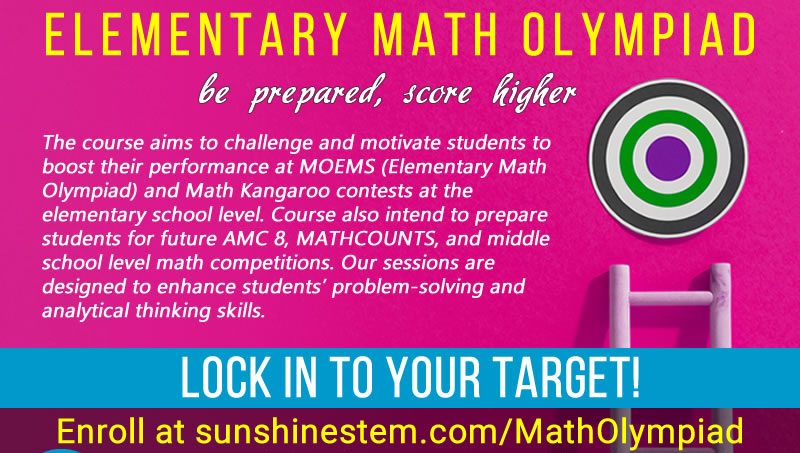
Math Olympiad is a team for students who love math and want an exciting challenge. Through weekly practice and guided instruction, students strengthen core problem-solving strategies, learn to explain their thinking clearly, and build confidence tackling non-routine, competition-style questions. Our lessons include logic puzzles, number theory, algebraic reasoning, geometry, and multi-step word problems, with plenty of time for collaboration and discussion. As students progress, the team prepares to participate in scholastic math competitions such as MathCounts and other local and regional contests.
Led by an award-winning Math Olympiad coach, students receive expert guidance and encouragement as they grow their skills and confidence.
Sunshine STEM Academy offers Elementary Math Olympiad Prep Course – In Person @ Buckhead and Alpharetta
This course is specifically designed to challenge and motivate students to excel in prestigious mathematics competitions, including the MATHCOUNTS Elementary Division, MOEMS (Mathematical Olympiads for Elementary and Middle Schools), and Math Kangaroo competitions. Additionally, it serves as excellent preparation for future advanced contests such as the AMC 8 and various other middle school level mathematics competitions. Throughout our carefully structured sessions, students will develop and strengthen their problem-solving abilities and analytical thinking skills.
Why MATHCOUNTS Important
For many families, it’s not just about the contest format—it’s about what the experience steadily builds in a student over weeks and months of practice: sharper speed and focus under timed pressure, stronger problem-solving that goes beyond memorizing steps, and the ability to stay calm when a question looks unfamiliar.
MATHCOUNTS-style training pushes students to develop habits that transfer far beyond any single meet. They learn to read carefully, choose efficient strategies, check work under a clock, and recover quickly after mistakes. They build number sense and mental math, but also the flexibility to switch approaches—drawing a diagram, working backward, testing cases, or looking for patterns—when a routine method won’t work. Just as importantly, students begin to enjoy the challenge: they become comfortable wrestling with hard problems, persisting through confusion, and seeing “I don’t know yet” as a normal part of learning.
The team aspect matters too. In a supportive group of peers who genuinely enjoy math, students experience healthy motivation and belonging. They explain solutions, compare strategies, and learn that there can be multiple elegant paths to the same answer. Over time, those skills and mindsets—accurate computation, clear reasoning, creative thinking, resilience, and confidence from community—often matter more than any award.
What is the MATHCOUNTS Competition Series?
MATHCOUNTS is a premier nationwide math competition designed for students in Grades 6–8. It focuses on building critical thinking, problem-solving depth, speed, and collaborative skills through a series of structured, in-person competitive rounds.
Who is eligible to participate?
-
Grade Levels: Only middle school students in grades 6, 7, and 8.
-
Duration: Students can participate for a maximum of 3 years.
-
Geographic Scope: Open to students in all 50 U.S. states, Washington D.C., U.S. territories (Guam, Puerto Rico, U.S. Virgin Islands), and select overseas schools affiliated with the U.S. Department of Defense or State.
My child’s school does not participate. Can they still register?
Yes. If a school does not officially support or register for the competition, students can enter as a Non-School Competitor (NSC). NSCs must be registered individually by a parent or guardian, and their progression through the initial tournament phases is determined strictly by their individual School-level scores.
How does a student advance through the competition?
The competition is a linear, four-tiered progression. Students must meet performance thresholds at each level to qualify for the next:
-
School Level: Conducted at the school or independently for NSCs to determine who moves on to local chapters.
-
Chapter Level: Local regional events held across the country.
-
State Level: A single official tournament hosted by each state or territory.
-
National Level: The ultimate national championship event featuring the top 4 individual qualifiers from every state.
What do the individual rounds look like during a tournament?
A typical competition lasts approximately 3 hours and is broken down into four distinct segments:
| Round | Focus | Core Format | Calculator Allowed? |
| Sprint Round | Speed & Accuracy | 30 problems in 40 minutes | ❌ No |
| Target Round | Logic & Deep Reasoning | 4 pairs of problems (6 mins per pair) | ✅ Yes |
| Team Round | Collaboration & Strategy | 10 problems in 20 minutes | ✅ Yes |
| Countdown Round | Head-to-Head Speed | Fast-paced oral round (<45 secs per question) | ❌ No |
Note: Individual-only competitors and NSCs do not participate in the Team Round. The Countdown Round is traditionally optional at local levels but strictly required at the National level.
What mathematical topics are covered?
The curriculum focuses heavily on creative application rather than rote memorization. The concepts span three primary analytical modules:
-
Algebra & Number Theory: Algebraic expressions, equations, proportional reasoning, fractions, percents, divisibility, remainders, and GCD/LCM.
-
Geometry: Plane geometry, coordinate geometry, solid geometry, angle relationships, and similarity ratios.
-
Data & Reasoning: Probability, combinatorics, combinatorics counting, logic word problems, statistics, and pattern recognition.
Does a top score reflect overall mathematical capability?
Not fundamentally. MATHCOUNTS heavily privileges speed-based execution alongside precision. Deep mathematical thinkers who prefer a slow, highly deliberate approach may find the tight time limits restrictive. Success requires balanced training in both conceptual mastery and pacing strategies.
How do MATHCOUNTS and the AMC (American Mathematics Competitions) differ?
While both are prestigious, they cultivate slightly different skill sets:
-
MATHCOUNTS: An in-person, multi-round tournament utilizing both individual and team components, where calculators are permitted in specific rounds. It heavily emphasizes speed, immediate strategic modeling, and verbal agility.
-
AMC 8 / AMC 10: A single-round, entirely individual, multiple-choice exam where calculators are strictly prohibited. It places a heavier focus on deep logical precision, formal math principles, and individual endurance.
What is the most effective weekly training structure?
To build consistent competition stamina, a standard preparation routine should divide weekly practice across three core pillars:
-
Speed Drills: Short, un-calculator-assisted problem sets targeting mental math fluency to minimize careless computation errors.
-
Strategy Sessions: Complex word problems focusing on mathematical modeling, diagram mapping, and smart estimation.
-
Mixed Sets: Multi-topic, multi-step problem sets practiced under strict simulated test conditions to build overall cognitive endurance.
If you’re exploring Math Olympiad pathways, our Knowledge Base article (Why Ivy League Math Stars Are Made Years Before High School) explains why many of the biggest “breakthroughs” in high school competitions are often set in motion years earlier. It breaks down how early math circles, contest exposure, and selective opportunities create compounding advantages—helping some students reach milestones like AIME/USAMO while late entrants face steeper odds—so families and educators can focus on building strong foundations rather than chasing last-minute acceleration.